
Tree on your house, blocking the driveway, or into power lines? Call 612-532-9996 now. · Live answering · Same-day emergency response
Home › Tree Services › Tree Health Care
ISA CERTIFIED ARBORISTS · MAPLE GROVE · MPLS · SINCE 2006
We’ll tell you when your tree needs nothing.
A stressed tree is not automatically a sick tree, and a sick tree is not automatically a job. A certified arborist looks at what is actually happening in the canopy, the trunk and the soil, names it, and tells you whether it is worth treating. Sometimes the honest answer is water and three years of patience.
Free estimates. Licensed and insured. 4.8 stars across 133 Google reviews.
You’ll speak with our scheduling team, who will arrange a visit from a certified arborist, not a salesperson.

Send a photo and a certified arborist will tell you what it is and whether it needs treating. No pressure, no salesperson.
ISA Certified Arborist · TCIA Member · MN Tree Care Registry #20190969 · ★ 4.8 stars across 133 Google reviews · Licensed and insured · Serving the Twin Cities since 2006
Why We Say Wait
The standard offer in this industry is an annual plant health care plan. A spring visit, a fall visit, a deep root feed, a preventive spray, billed every year whether or not the tree ever needed any of it. It is a good business, and for a tree that is genuinely under stress it is the right business.
For most healthy trees in decent soil, it is unnecessary.
The problem is that a homeowner cannot tell the difference, and almost nobody in this trade is paid to explain it. Thinning leaves, early color, a dead branch high in the crown: those can be a disease, or they can be two dry Augusts in a row and a tree that will be fine.
So we diagnose before we sell anything, and the diagnosis is free.
An arborist looks at the whole tree, names what is actually going on, and tells you what it will cost to treat and what it will cost to do nothing. When the answer is that it needs nothing, that is the answer you get.
★★★★★
“He was also transparent with me about not spending another dime on one of my trees that appeared stressed and giving it a few years before deciding what to do with it, saving me from doing unnecessary or even harmful work on that tree.”
Courtney Barton · Google review
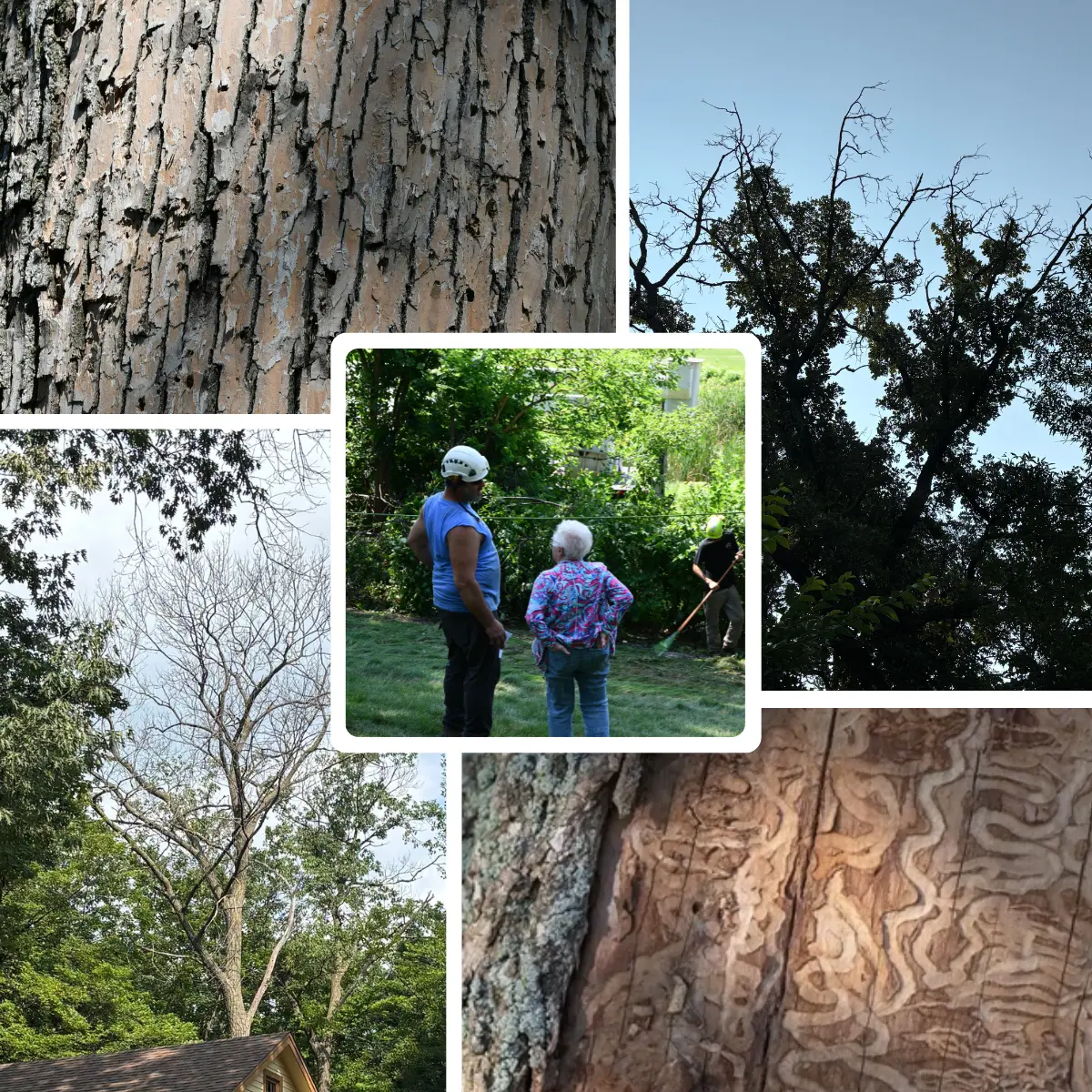
The Diagnosis
A tree tells you what is wrong with it in about six places. Most of them are not the leaves, which is where homeowners look first.
1
Trees die from the top. Dieback in the upper crown while the lower branches still look fine is the earliest reliable signal, and it is the one you cannot see from a window.
2
The base should widen where it meets the ground. If it goes into the soil like a telephone pole, the tree is buried too deep or girdled by its own roots, which is slow and usually fixable.
3
Short new shoots mean the tree is running out of something. Comparing this season’s growth to the previous two says more than any single symptom does.
4
What matters is not the wound but whether the tree is sealing it. A tree closing over a ten-year-old cut is winning. One that is not is telling you about decay you cannot see.
5
Compaction, mulch piled against the trunk, a lawn irrigation system running daily. A great deal of urban tree decline starts in the top few inches of soil rather than with any insect.
6
Oak wilt, Dutch elm and emerald ash borer are species-specific and they move locally. Knowing what has been confirmed within a few blocks changes the whole reading.
None of that requires a lab. It requires somebody who has looked at several thousand trees, which is what the certification is actually for.
What We Actually Do
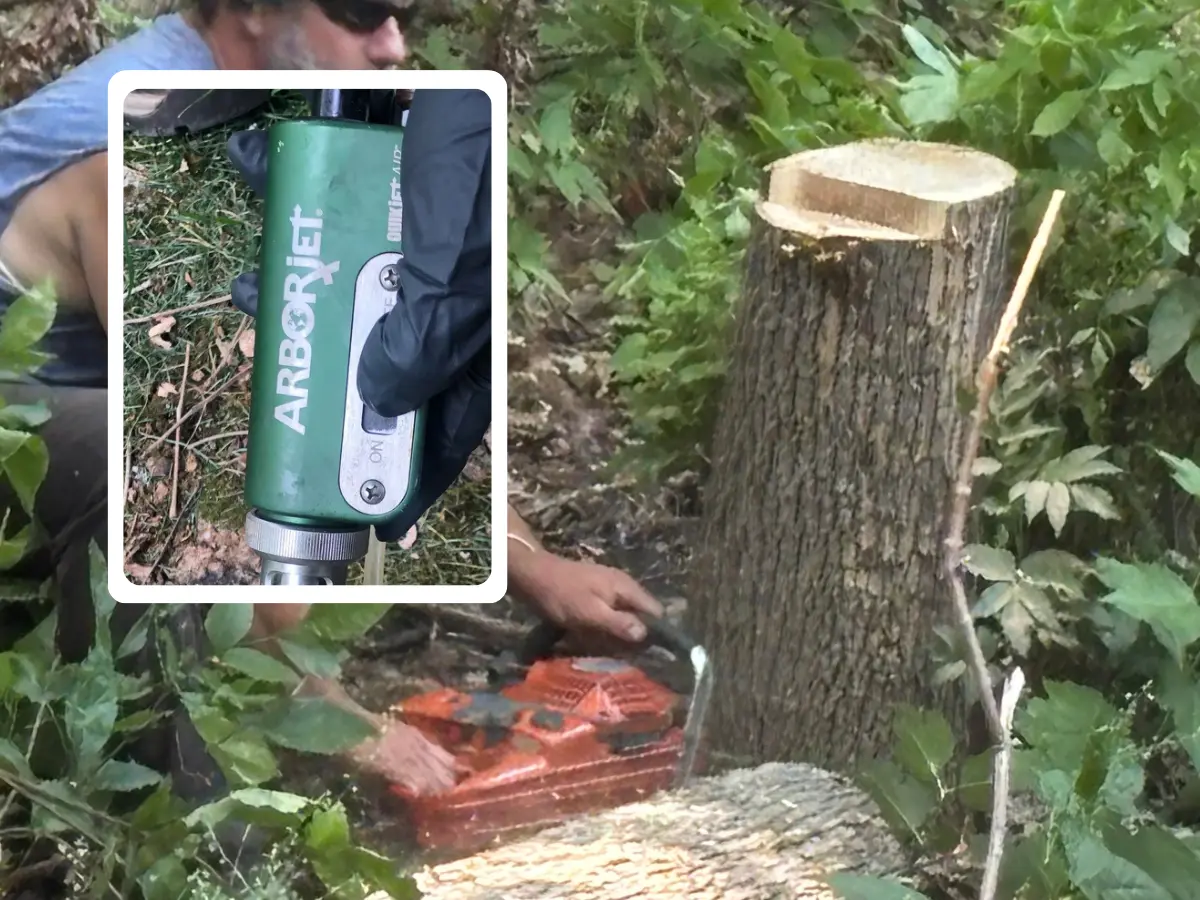
Trunk injection for ash trees worth saving, applied by a licensed applicator because the most effective product is a restricted use pesticide. Every two to three years, not annually.
Targeted treatment once the problem is identified and named. Oak wilt, Dutch elm, apple scab, needle cast, borers and scale each want a different answer and a different season.
For trees that are actually short of something. Compacted urban soil, a buried root flare and a tree that has been mowed around for thirty years are all soil problems wearing a canopy symptom.
Removing dead, diseased and crossing wood so the tree seals its own wounds and fails less. Detailed on our tree trimming and pruning page.
We do not do cabling and bracing. People ask, and the honest answer is that it is a specialty worth having done properly by somebody who does it constantly, and we would rather refer you than learn on your tree.
Timing Is Most of It
Almost every tree care question is really a timing question. The right treatment in the wrong month does nothing, and some of them do harm. This is the year as it actually runs in the Twin Cities. Where the timing is set by state guidance rather than by us, we say so.
What matters
Full dormancy, hard frozen ground
What to do
Best month of the year for structural pruning. No disease pressure, the structure is visible, and frozen ground means equipment does no damage to the lawn. Why winter works so well
What matters
Still dormant, late-winter storms
What to do
Pruning continues. Check for storm and snow load damage, and for rubbing and crossing branches now visible without leaves
What matters
Dormancy ending, sap moving
What to do
Last of the safe dormant pruning. Get oaks and elms done before the beetles fly
What matters
Oak wilt window OPENS
What to do
Stop pruning oaks, and treat elms the same way. Minnesota DNR guidance is no oak pruning April through July, and elms carry the same beetle-to-fresh-wound risk. Look for frost cracks and winter salt damage along drives and walks
What matters
EAB adults emerge, canopy fills
What to do
Ash injection season opens. The MN Department of Agriculture puts trunk-injected emamectin benzoate at May through September, while the canopy is full and the tree is not under heat or drought stress. Apple scab shows on crabapples now
What matters
Peak oak wilt beetle activity
What to do
Still no oak or elm pruning. Good month for ash injection: full canopy, no heat stress yet. Newly planted trees need deep watering, not frequent watering
What matters
Heat and drought stress
What to do
Water deeply and rarely: a slow soak at the drip line beats daily sprinkler time. Do not fertilize a drought-stressed tree, which pushes growth it cannot support
What matters
Second-flush growth, borer activity
What to do
Watch for early color and thinning in the upper crown, which is the first honest signal of trouble. Late-season insect treatment where identified
What matters
Root growth accelerates
What to do
A strong planting month for container and balled-and-burlapped stock, and roots keep growing well after the leaves come off. Bare-root trees go in early spring instead. Soil work and deep root feeding are effective now
What matters
Leaf drop, dormancy beginning
What to do
Final deep watering before the ground freezes, especially for evergreens and anything planted this year. Mulch, but never against the trunk
What matters
Dormancy
What to do
Oak and elm pruning reopens, and everything else is easier now too. Wrap thin-barked young trees against sunscald and rabbits
What matters
Full dormancy
What to do
Structural pruning, hazard assessment, and snow load checks after the first heavy storms
Do not prune an oak between April and July. This is Minnesota DNR standing guidance, reissued every spring. The beetles that spread oak wilt are active and drawn to fresh cuts, and a pruning wound in June can kill a healthy oak. Elms are not named in that release, but Dutch elm disease moves the same way and every arborist in the state treats them the same. More on that on our tree trimming and pruning page.
If you are treating an ash, go early in the season. Injection needs a full canopy and a tree that is moving water, so the season runs May into September and the front of it is better than the back. The timing, the sources behind it and the whole treat-or-remove decision are on our emerald ash borer page.
The One With a Deadline
Ash is the one tree care decision in Minnesota with a clock on it, and it is the one where a homeowner is most likely to be pushed in whichever direction the company they called happens to profit from.
We inject ash trees and we remove them, so we gain nothing by steering you either way. Rather than an opinion, we work from the threshold the Minnesota Department of Agriculture publishes: above about 50 percent canopy decline, an ash is unlikely to recover even if treated.
How to tell whether your tree has it, which side of that line it is on, what treatment commits you to, and why a dead ash is a harder removal than a live one are all on our emerald ash borer page.
What to Expect
Free, and it includes the possibility that the answer is nothing.
Not “it looks stressed.” What it is, how far along, and what happens if it is left alone.
Both numbers, in writing, including the removal cost if that is where this ends up in three years.
Half of this job is calendar.
What Drives the Price
We publish removal pricing on our tree removal page because a removal can be priced from size and access. Treatment cannot, because until somebody has identified the problem, nobody knows what is being bought.
What moves the number:
Injection is dosed by diameter, so a 30-inch ash costs materially more to treat than a 12-inch one, every cycle.
A soil and root problem is often cheap to correct. A confirmed vascular disease usually is not.
Treating four ash trees on one visit is not four times the cost of treating one.
Ash injection is a two to three year commitment. The honest number is the one over ten years, not the one on the first invoice.
Which is the question the free assessment answers before you spend anything.
★★★★★
“He was also transparent with me about not spending another dime on one of my trees that appeared stressed and giving it a few years before deciding what to do with it.”
Courtney Barton · Google review
★★★★★
“He saved me a bundle by suggesting ways to save a tree rather than take it down. He had a true appreciation for the trees, especially my ancient hackberry.”
Renee Rauch · Google review
★★★★★
“I was told by 2 landscaping companies that they would have to be cut down, but they now look like they are on the way to recovery.”
Judy Lemke · Google review
Read all 133 Google reviews
Usually not. Thinning leaves, early color and a few dead branches are more often two dry summers, compacted soil or a root flare buried too deep than they are a disease. The way to tell is to have somebody look at the canopy from the top down, which is the part you cannot see from the ground.
No. It is a genuine specialty and it is worth having done by somebody who does it constantly rather than occasionally. We will tell you if we think your tree needs it, and point you at someone who does it properly.
April through July. That is Minnesota DNR guidance, not a preference. The beetles that carry oak wilt are active then and are drawn to fresh cuts, so a June pruning wound can kill a healthy oak. Elms are the same.
Only if the tree is short of something, which is less common than the people selling fertilizer suggest. A soil test costs very little and answers it. Fertilizing a drought-stressed tree actively makes things worse, because it pushes growth the tree cannot support.
We will build you one if your trees genuinely need ongoing attention, and we will tell you if they do not. We would rather have you call us in three years than bill you every spring for a visit your trees never needed.
Structural pruning, the Minnesota pruning calendar, and why we will not top your tree.
When an ash is too far gone to treat and needs to come down safely.
Free assessment from a certified arborist, in writing, including the years we tell you it needs nothing.
Diagnosis first. Always.
Loading the estimate form…