What to Do in a Tree Emergency: 7 Steps
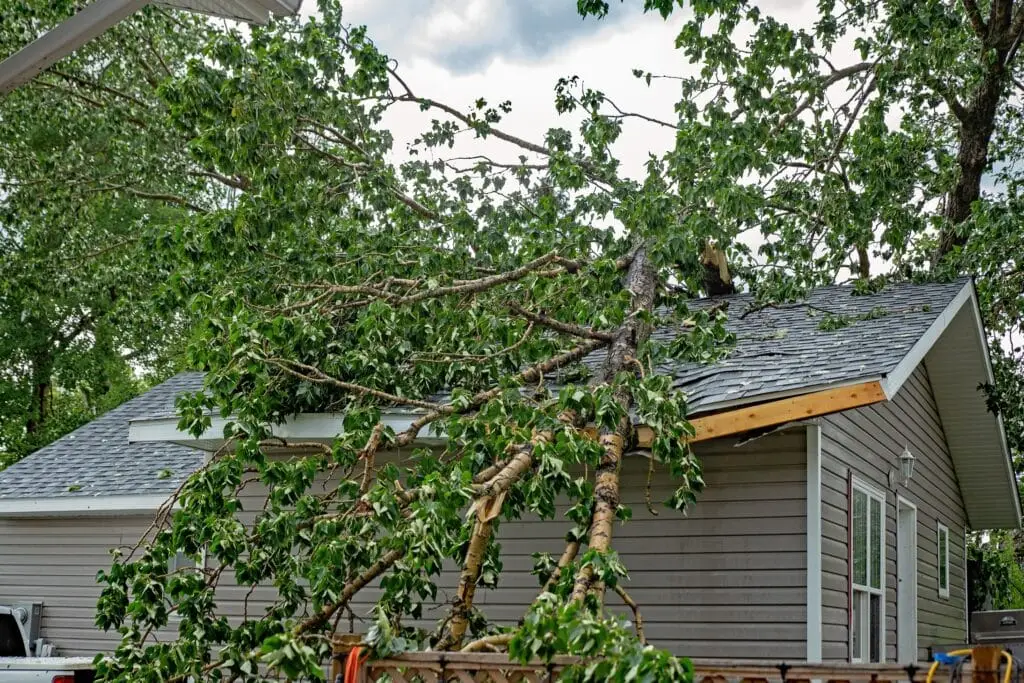
A tree just came down — on your house, across the driveway, or onto a line — and you need to know what to do in the next five minutes. Here’s the short version from an ISA Certified Arborist who’s cleared storm and disaster damage across the Twin Cities since 2006: if a tree or limb is on a structure, blocking access, or anywhere near a power line, don’t try to handle it yourself. Get everyone clear, and call.
Tree emergency right now? Call (612) 532-9996 — 24/7 answering, same- or next-day response.
If it’s not an immediate hazard, you’ve got a minute. Here’s how to stay safe and protect yourself for the insurance claim.
1. Get safe, then assess from a distance
Safety first — yours, your family’s, and anyone nearby. Stay clear of damaged trees and especially downed lines. If you see sparks or suspect a live wire, get everyone away and call 911 and your utility.
Once it’s safe, look — from a distance — for the signs a tree is still dangerous: a cracked or split trunk, roots lifting out of the ground, limbs hung up overhead, or a tree leaning hard. Don’t walk under a hung-up limb. That stored energy is exactly what hurts people in the hours after a storm.
2. Call a certified arborist — and know what to expect
Call Urban Tree at (612) 532-9996. Here’s what happens when you do: we ask what came down and what it’s resting on or near, then tell you honestly whether it’s a now job or a morning job — not every fallen branch is a 2 a.m. emergency, and we’ll say so rather than charge you like it is. Real hazards get scheduled same- or next-day.
Choose a company that’s licensed, insured, and arborist-led. On a tree hanging over your house, the cheapest crew is almost always the one cutting corners on safety.
Need it removed now, not just advice? → Emergency Tree Removal
3. Secure the Area
While you wait, cordon it off — cones, tape, or rope — and keep kids and pets well away. A downed tree still carries hidden dangers: sharp limbs, an unstable trunk, branches under tension. Mark off anything sketchy and keep everyone back until the crew arrives.
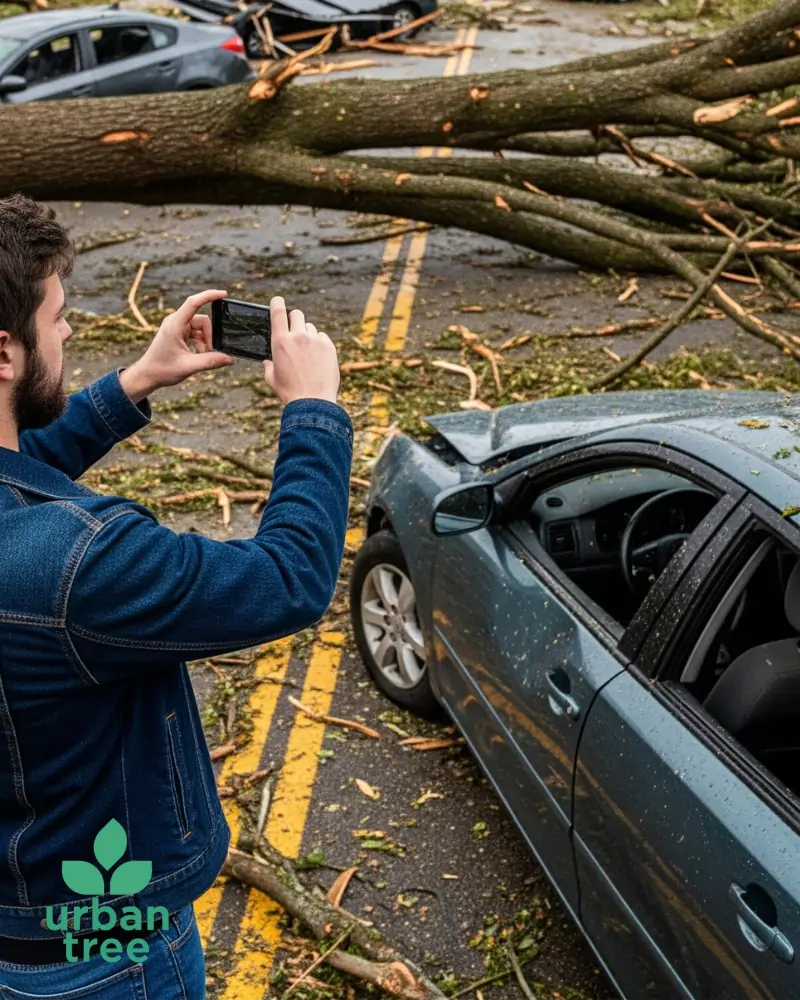
4. Photograph everything — before anything moves
This is the step people skip and regret. Take clear photos and video of the tree, the damage to your house, garage, or car, and the surrounding area. Most storm and impact damage is a covered insurance claim — but coverage turns on documentation, and an adjuster can’t see what you didn’t capture.
(When we arrive, we document too, and hand you records built for the claim — but get your own shots first, before anything is touched.)
4. Photograph everything — before anything moves
This is the step people skip and regret. Take clear photos and video of the tree, the damage to your house, garage, or car, and the surrounding area. Most storm and impact damage is a covered insurance claim — but coverage turns on documentation, and an adjuster can’t see what you didn’t capture.
(When we arrive, we document too, and hand you records built for the claim — but get your own shots first, before anything is touched.)
5. Treat every downed line as live dangerous electricity
Always assume a downed wire is energized. Don’t approach it, don’t touch anything it’s touching, and report it to your utility company immediately — not to us. The utility has to make the line safe first; we coordinate with them from there. If a tree is blocking a road or leaning on a structure, keep clear and let the crew handle it.
6. Clear small debris safely — leave the big stuff
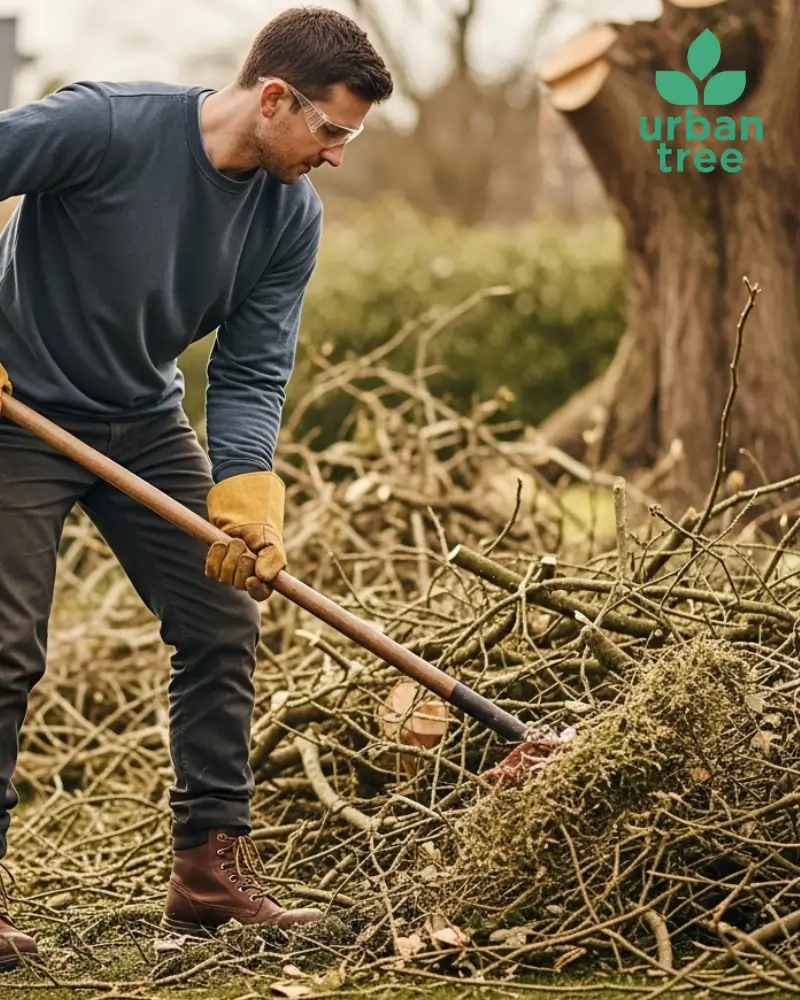
If you’re clearing small branches, wear real protection: gloves, sturdy boots, and eye protection. Dispose of debris per local regulations. But leave anything large, hung up, or under tension to the crew — that’s where the injuries happen. We handle storm debris cleanup as part of the job and haul it off.
7. Prevent the next one
Once the emergency’s handled, a quick look at what’s left standing catches the next hazard before it falls — a cracked co-dominant stem, a leaning neighbor tree, a dead ash that’s gone brittle. A little routine trimming and assessment is what keeps a storm from turning into an emergency in the first place.

What to expect from an emergency tree service
So there are no surprises, here’s how Urban Tree runs an emergency, start to finish:
- You call, we triage — what came down, what it’s on, who’s at risk — and tell you straight whether it’s a now job or a morning job.
- We schedule the response — same- or next-day for genuine hazards. A window, not a vague “sometime.”
- An arborist reads the hazard on arrival — tension, lean, what’s holding what. The plan comes before the first cut.
- We remove it safely — for anything heavy or over a structure, crane-assisted removal lifts sections up and away from your roof, not down toward it.
- We document and clean up — photos for your insurer, debris hauled, site left clean.
Why homeowners call Urban Tree first
Emergency tree work is judgment under pressure, and that comes down to who’s running the job. Every emergency we handle is led by an ISA Certified Arborist — owner Gabe Tschida — not, as one customer put it, “a fly-by-night guy with undeserved self-confidence and a chain saw.” Serving Minneapolis–Saint Paul since 2006, with 4.8 stars across 130+ reviews, a lot of them earned on the worst night of someone’s year.
“In the middle of the night a large portion of our 45-year-old silver maple fractured away from the trunk, falling on our deck and house. Early the next morning, Father’s Day, Urban’s crew was in our yard to remove it. We were in awe watching the skill they worked with. We’ll never use anyone else.”
— Norm & Donna B., Twin Cities homeowners
Tree down and need it gone? Call (612) 532-9996 or request an estimate online. For heavy or dangerous trees, ask about crane-assisted removal.
Serving Maple Grove, Minneapolis, St. Paul, and the surrounding Hennepin County metro since 2006.