
Tree on your house, blocking the driveway, or into power lines? Call 612-532-9996 now. · Live answering · Same-day emergency response
Home › Tree Services › Tree Trimming and Tree Pruning
ISA Certified Arborists · Serving the Twin Cities since 2006
Most certified arborists will tell you what you are not allowed to do to your own trees. We will not. We will tell you what a cut does, how long it lasts, and what it is likely to cost you in ten years. Then, if it is legal and it is safe, we will do the work you asked for, and we will do it properly.
4.8 stars across 133 Google reviews. Licensed, insured, and a TCIA member.
Send a photo of the tree. We will tell you straight, even if the answer is “leave it alone this year.”
ISA Certified Arborist · TCIA Member · MN Tree Care Registry #20190969 · ★ 4.8 stars across 133 Google reviews · Licensed and insured · Serving the Twin Cities since 2006
Topping has a bad name in this trade, and on a healthy tree in its prime the name is deserved. Cut a vigorous maple back to stubs and it panics. It throws out water sprouts, dozens of fast weak shoots attached to the surface of the wound instead of anchored in wood. The open stubs cannot seal, so decay walks down into the trunk. Three years later you have a taller, denser, weaker tree than the one you started with, and another bill.
That is true, and we will always tell you it is true. What we will not do is pretend it is the only truth.
There are trees where taking height out of the top is the right call. An old tree in decline, hollowing at the base, shedding limbs, with more dead wood in it every season, can often be kept standing for another decade by reducing its height and clearing the dead top out of it. Arborists have a name for that work. It is called retrenchment, it copies what an ageing tree does to itself naturally, and it is the difference between a tree you keep and a stump you pay for. Done properly it leaves the tree enough leaf to feed itself and the regrowth comes back well attached. Done as a hack job it does the opposite. Knowing which is which is what the certification is actually for.
And there are plain human reasons that have nothing to do with arboriculture at all. A view you bought the lot for. A garden that has not had full sun in fifteen years. A limb over a bedroom you are tired of listening to on windy nights. Those reasons are yours to have. This is Minnesota, it is your land, and you have been paying the taxes on it.
So here is how we handle it. We ask why. Not to talk you out of it, but because the answer usually points at a better way to get the thing you actually want, and sometimes it does not, and then we do it your way. We tell you plainly what the cut does and how permanent it is, so that nobody is surprised in three years. We put it in writing before anyone starts. And then we do the work, cleanly, to the highest standard the job you have chosen allows.
Gabe is an ISA Certified Arborist, and there are people on this crew who know more than he does about specific pruning techniques. That expertise is here to give you a straight answer. It is not here to give you permission.
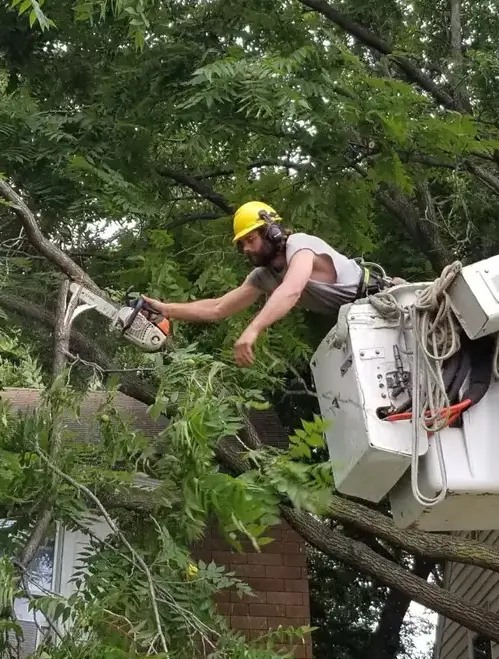
“Instead of trimming all of our trees, which he had originally quoted, he encouraged us to wait until the fall.”
Clara Nydam
That was a job we had already quoted, and then talked ourselves out of. It runs both directions. If the timing is wrong we will tell you to wait, and waiting costs you nothing. If you want work done that we would not have suggested ourselves, we will tell you that too, and then we will ask when you want us out there. If a tree is genuinely stressed, that is a job for tree health care, not a saw.
There are cuts that cannot be made without putting a climber or a groundsman somewhere they should not be. That is not a negotiation and it never has been.
Your property line is where your decision stops. If a cut sends weight, debris or a failure risk onto the lot next door, we are solving that first, and sometimes solving it means the answer is no.
Oak wilt and Dutch elm disease travel on fresh cuts made in the wrong month, and they do not stop at the fence. This is the one place we will ask you to wait, and the reason is that the risk is not confined to your yard. The months, and the state guidance behind them, are in the timing section below.
Boulevard trees are not yours, whatever it feels like when you mow around them. Some cities have heritage tree rules, and shoreland and wetland lots have their own. We will help you find out exactly what applies to your address, and once you have the permit we will do the job.
Everything else is a conversation, and most of those conversations end with us doing the work.
Good pruning is subtractive and conservative. A trained arborist takes the least wood that achieves the goal, and every cut is made at a specific place for a specific reason. Here is the whole list.
The first pass on almost every tree, and often the only pass a healthy tree needs. Dead wood is where decay and insects get in, and it is what falls in a storm.
Two branches grinding against each other wear through the bark and open a wound that never closes. One of them comes out, and it is the one with the worse attachment.
Two stems of equal size growing from the same point form a narrow V with bark trapped inside it. That is the joint that splits in a wind event. Caught early, it is one small cut.
Limbs over a roof drop debris into the gutters and give squirrels a bridge. Clearance work is real pruning, done to the branch collar, not a hedge trim on a tall stick.
That is the default. It is what we do when you tell us to give the tree what it needs, and it is what the large majority of trees actually need. A tree pruned this way should not look like it has been pruned at all.
If you want something beyond that list, say so at the estimate. That is the conversation, and it is a conversation we are happy to have standing under the tree.
Gabe is an ISA Certified Arborist, and the pruning plan is made by somebody qualified to make it. Two people on the crew have deeper knowledge than he does on specific techniques, and on the right job that is who is making the cut. You get the expertise whether you take the advice or not.
Every cut lands at the collar so the tree can seal it. No flush cuts, no stubs. This is the entire difference between a wound that closes and a wound that rots.
Oak wilt and Dutch elm move on tools and on fresh wounds. Sanitising between trees is not optional in Minnesota.
Mats or plywood under the drop zone and the equipment, so the lawn you are paying to keep looking good survives the visit.
Brush chipped and taken. Chips left only if you want them.
“They raked up all the debris and even took leaf blowers to fluff up the grass. Seriously!” Jeff Matthies
For most trees, yes, and for a good number of them right now is the ideal time rather than a compromise. Two species are the real exceptions, and they are the exception for a reason that has nothing to do with your preferences and everything to do with your neighbours’ trees. Here is the honest answer for each.
Yes, and it should not wait
Immediately, whatever the month or the species
A broken limb is a hazard and an open wound already, so the calendar does not apply. If it is over a roof, a drive or a walkway, that is emergency tree work.
Yes
Late spring and early summer, once the leaves are fully out
University of Minnesota Extension recommends pruning these after the leaves are fully expanded. The heavy sap bleeding people worry about happens in late winter, it is cosmetic, and it does not harm the tree. We take no more than a quarter of the live foliage in one visit.
Yes
Any time through the middle of summer
Extension puts arborvitae and juniper in the “prune any time through midsummer” group. If a screen has outgrown a property line or a driveway sightline, there is no reason to wait.
Yes, if they have finished flowering
Immediately after the blooms drop
These set next year’s flower buds within weeks of finishing. Prune them in winter, which is when most people think about pruning, and you cut off next spring’s flowers. This is the one job where waiting is the mistake.
Yes
Late winter for major structural work, any month for the rest
Linden, hackberry, honeylocust, ash and the rest can be pruned in any season. Dormant is easier for reading structure on a big reduction. Summer has its own advantage: dead wood is unmistakable when everything alive is in leaf.
Usually
Late winter for spruce and fir; pines before the new needles harden off
Conifers are the one group where the ideal window is genuinely narrow, but clearance and deadwood work is fine year round.
Dead wood and genuine hazards only
The dormant season. Roughly November through March.
Oak wilt. The Minnesota DNR reissues “don’t prune oaks April through July” every spring, most recently 6 April 2026, because that is when the beetles carrying the fungus are drawn to fresh wounds. University of Minnesota Extension is more cautious still and says do not prune oaks April to October. An infected red oak can die in a single season. If a limb genuinely has to come off inside that window, the DNR’s own guidance is to seal the cut immediately, because a fresh wound stays attractive to the beetles for about five days. That is exactly what we do, and it is the only oak work we will take in the summer.
Dead wood and genuine hazards only
November through February
Dutch elm disease, the same beetle-to-fresh-wound mechanism. University of Minnesota Extension is blunt about it: elms should only be pruned when they are dormant, November through February. When we do take hazard wood off an elm, it leaves the property rather than sitting in a pile, because the beetle breeds in recently dead bark.
This is the one place on this page where we will not simply do what you ask, and it is worth saying plainly why. Oak wilt does not stay on your property. A cut made on your red oak in June can take out a neighbour’s oak two years later, and it can move underground through connected root systems down a whole block. So if you call us in June about an oak, we will book you for November and tell you why, and that is a job we are turning down in our busiest month. If you call us in June about the maple over your driveway, that is exactly the right time to be calling. Here is why winter is the right season for oaks and elms.
An arborist walks the property, looks at every tree you are asking about, and tells you what each one actually needs. Sometimes the answer is nothing.
Which trees, which cuts, what it costs, and when we can do it. If the right time is five months away, the estimate says so.
Drop zones set, mats down where they are needed, saws sanitised between trees. Climbers or the lift, depending on access.
Brush chipped and hauled, the lawn blown clean, and a walk-through so you can see every cut before we leave.
Two trees that look the same from the street can be quoted very differently, and that is the thing homeowners find hardest to trust. Here is exactly what changes the number.
A 25-foot ornamental and a 70-foot silver maple are different jobs with different gear. Species matters too, because some woods are heavier and some crowns are far denser than they look.
A front-yard tree we can reach with the lift is the cheapest scenario there is. A backyard tree behind a fence, over a pool, or with no gate wide enough for equipment has to be climbed and rigged down piece by piece, and that is time.
A limb over an open lawn drops. The same limb over a roof, a fence, a greenhouse or a power line has to be roped and lowered, and that can double the hours on one branch.
A deadwood pass on a healthy tree is a fraction of a full structural prune on a neglected one. Trees pruned on a cycle get cheaper over time.
Doing six trees in one visit costs meaningfully less per tree than doing one, because the setup and the haul are shared.
Chipped and hauled is standard. Wood cut to length and stacked for you, or chips left for your beds, changes the number in either direction.
We do publish real numbers where we have them. The removal ranges on our tree removal page are Gabe’s actual figures, not marketing ranges. We have not published pruning ranges because pruning varies more per job than removal does, and a range wide enough to be honest would not help you. What we will do is give you a firm number in writing before anyone starts.
“Instead of trimming all of our trees, which he had originally quoted, he encouraged us to wait until the fall.”
Clara Nydam
“Having a certified arborist matters; this is not a fly-by-night guy with undeserved self-confidence, ‘sure, we have a chain saw.’ This might not be the cheapest but quality matters.”
Katie Trotzky
“They left our yard in better condition than it was before the project started.”
MIKE Anderson
4.8 stars across 133 Google reviews
For most trees, any month, and the popular answer of “always wait for winter” is wrong often enough to cost people money. University of Minnesota Extension recommends pruning maple, birch and walnut after the leaves are fully out in late spring or early summer. Arborvitae and juniper can be pruned any time through midsummer. Lilac, crabapple and other spring bloomers have to be pruned right after they flower, because pruning them in winter removes next spring’s flowers.
Late winter is genuinely best for major structural work on a large hardwood, because the structure is readable with the leaves off.
The two real exceptions are oak and elm. The Minnesota DNR says do not prune oaks April through July, and Extension is more cautious still at April to October. Extension says elms should only be pruned November through February. Both restrictions exist because beetles carrying oak wilt and Dutch elm disease are drawn to fresh cuts.
Broken or hanging limbs are the exception to all of it, on any species, and should be dealt with immediately.
Less often than most people think. A young tree benefits from structural pruning every 2 to 3 years, which is cheap and prevents expensive problems later. A healthy mature tree often needs nothing more than a deadwood pass every 3 to 5 years. If a company tells you every tree needs annual trimming, they are selling a subscription, not arboriculture.
Probably, and we are going to ask you why first.
Here is what you need to know before you decide. Topping cuts a tree back to stubs and takes its crown off. On a healthy tree the response is dozens of weak fast shoots attached to the surface of the wound rather than anchored in wood, so it comes back taller, denser and structurally weaker than it was, and the open stubs cannot seal, so decay moves down into the trunk. It usually costs more over ten years than the removal would have, and the tree often comes out anyway.
That is the honest answer and it is why we will always offer you the alternative first. On most trees there is a better way to get what you are after, and on an old declining tree there is a real technique for bringing the height down that keeps the tree alive rather than killing it slowly.
But it is your tree and your property. If you have heard all of that and you still want the height gone, we will put the decision in writing so there are no surprises later, and then we will do the work as cleanly as that particular job can be done.
This is the request that usually comes in as “top it.” There is a real technique called crown reduction, where the height comes down by cutting back to a lateral branch big enough to take over as the new leader. It is slower and more skilled than topping and it does not damage the tree. It also has limits. Not every tree can be meaningfully reduced, and if yours cannot we will tell you so, and we will tell you what the remaining options actually cost you, including the one we would not have picked. Then it is your call.
For a tree standing on your own lot, in most Twin Cities suburbs the answer is no, and the decision is yours. There are three situations where that changes, and they catch people out.
Boulevard trees are not yours. The tree in the strip between your sidewalk and the street belongs to the city even though you mow around it. In Minneapolis those trees are the Park and Recreation Board’s, and in Saint Paul any work on a boulevard tree, trimming included, needs a permit from Saint Paul Forestry. Several other metro cities run it the same way.
Some cities protect specific trees. Heritage or significant tree ordinances, and tree preservation rules tied to grading, lot splits and building permits, vary city by city and are worth checking before you plan anything.
Shoreland and wetland lots have their own rules, whoever owns the tree.
We check this for your address before we quote, and the answer takes us about five minutes. Tell us where you are and what you are thinking about.
Yes, and the list is short. We will not do work that cannot be performed safely. We will not do work that puts your neighbours or their property at risk. We will not make cuts that spread oak wilt or Dutch elm disease to trees that are not yours, which is why oak and elm wait for the dormant season. And we will not do work your city prohibits, though we will help you get the permit if one exists.
Outside that list, our job is to make sure you know exactly what you are buying, and then to do it well.
In Minnesota, no. Anyone with a saw can sell tree trimming, which is exactly why the standard varies so much. Urban Tree is ISA Certified, a TCIA member, and on the Minnesota Tree Care Registry as licence #20190969. Ask whoever you hire for all three.
It depends on size, access, what is underneath the tree, and how much is actually coming out. A deadwood pass on a healthy front-yard tree is a fraction of a structural prune on a neglected backyard one. We do not publish pruning ranges because they would have to be so wide to be honest that they would not help you. You get a firm number in writing before anyone starts.
Good pruning does not. Every cut is a wound, so a trained arborist takes the least wood that achieves the goal and puts every cut where the tree can seal it. Bad pruning absolutely does hurt a tree, and topping is the clearest example. The damage is usually invisible for two or three years, which is why it keeps being sold.
If a tree is stressed, thinning or dropping limbs, the answer is diagnosis, not a saw.
When a tree really is finished, we will say so, and our removal pricing is published.
For big trees in tight backyards, a crane is usually the cheaper option, not the expensive one.
Send a photo, or have an arborist walk the property with you. We will tell you what each tree actually needs this year, what your options are if you want something different from that, and what each one costs. Sometimes the answer is that a tree needs nothing, and we will say so. The decision stays yours either way.
Loading the form…
Ask your neighbour, then call.
Loading the estimate form…