
Tree on your house, blocking the driveway, or into power lines? Call 612-532-9996 now. · Live answering · Same-day emergency response
Home › Tree Services › Tree Removal
ISA-Certified Arborists · Fully Insured · Minneapolis & Twin Cities Tree Removal Since 2006
Not sure it has to come down? We’ll tell you straight, even when the answer costs us the job.
Most homeowners who call us about tree removal in Minneapolis or the suburbs have spotted something wrong: a tree that’s dead, split, leaning toward the house, or dropping limbs after the last storm. Some of those trees have to come down, but some don’t. So an ISA-Certified Arborist will look at yours, tell you honestly which one it is, and give you a written estimate with the scope, the price, the cleanup, and the schedule spelled out.
When you call, you’ll speak with our scheduling team, and they’ll set up a visit from a certified arborist, not a salesperson.
Send a photo so our certified arborist has the info they need to schedule you for the right estimate.
The question nobody else answers first
Plenty of companies will remove any tree you point at. We won’t. Before we quote any tree removal in Minneapolis or the suburbs, a certified arborist looks at the tree’s condition, its structure, what’s under it, and whether the problem can be fixed with pruning or treatment instead. In fact, sometimes the honest answer is “leave it alone and check it again in a few years.” We’ve given that answer more than once, because we’d rather give it than take money for work you don’t need.
“He was also transparent with me about not spending another dime on one of my trees that appeared stressed and giving it a few years before deciding what to do with it, saving me from doing unnecessary or even harmful work on that tree.”
Courtney Barton, Twin Cities homeowner
“He saved me a bundle by suggesting ways to save a tree rather than take it down. He had a true appreciation for the trees, especially my ancient hackberry.”
Renee Rauch, Twin Cities homeowner
Still not sure which one you’ve got? That’s exactly what the free estimate is for.
No surprises, in writing
An ISA-Certified Arborist evaluates the tree's condition, structure, and risk, as well as access, nearby structures, and utilities. Then we build the removal plan around your property.
Exactly what's included: the removal method, the equipment, cleanup, stump options, timing, and the price. Alex M.: "They stick to their estimates and there are no surprises."
Ground protection mats, plywood, and a mapped equipment path go down before anything moves, because your lawn, driveway, and landscaping are part of the job, not collateral damage.
Climbing and sectional dismantling, aerial lift, crane or boom-truck assist, or a conventional fell. We choose it for your site rather than for our convenience.
Brush, logs, and sawdust are hauled off. Then we rake the site and blow it clean. In fact, one customer said they "even took leaf blowers to fluff up the grass."
Stump grinding below grade, grindings removed, plus grading and professional resodding when you want the spot to look like the tree was never there.
On a tight Minneapolis or suburban lot, the right tree removal method often means a crane or boom-truck assist. Stump grinding, on the other hand, is quoted as its own line item so you can choose.
From your call to the final walk
1
Call, or send the short form and add a photo of the tree, because a photo tells us more than a paragraph. The whole thing takes about thirty seconds.
2
Gabe or Tim looks at the tree, the access, and the surroundings. Then he tells you whether it should come down, what it’ll take, and what it’ll cost, without pressure and without a menu of ten options you didn’t ask for.
3
Scope, method, equipment, cleanup, stump, schedule, and price, all in writing. That way you know exactly what’s happening before anyone starts a saw.
4
We protect the property, take the tree down, haul it out, and clean the site. Then we walk it with you before we leave. Stump grinding is usually a quick follow-up visit afterward.
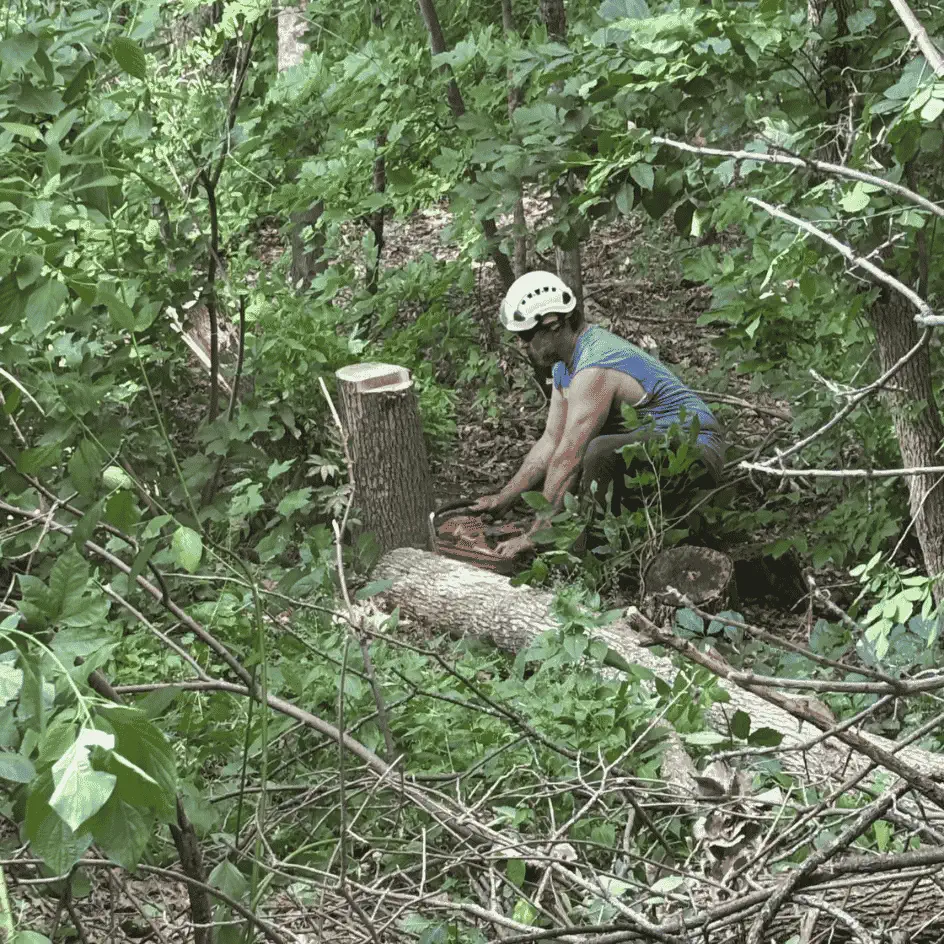
Permits, street closures, and utility coordination for a tree removal in Minneapolis or the suburbs: we handle them. For example, when a job required a street shutdown for a large dead oak, we secured the city permits ourselves, so the homeowner didn’t have to make a single call.
A REAL PLYMOUTH REMOVAL
Plymouth, Minnesota, July 2026
BEFORE
DURING
After
The concern
An oak failed into the backyard and left broken limbs hanging in the maple and elm above the work area. In addition, seven dead ash stood around the yard perimeter, with emerald ash borer among the reasons.
The constraints
Everything was in the back, so every trunk section and limb had to cross the lawn to reach the street. Also, the hangers overhead had to come down before anyone could work underneath them.
The plan
Ground protection mats went down first, to build one equipment route across the lawn. Then the crew cleared the hangers and took the rest of the failed oak. Afterward, the seven ash came out while the crew and the loader were already set up. Finally, everything was hauled out and the lawn raked before the crew left.
The result
Eight trees out in one visit, wood and brush hauled off the property, and the lawn raked open again with the soccer goal back in the middle of it.
WHAT THE JOB TOOK
One tree, several ways down
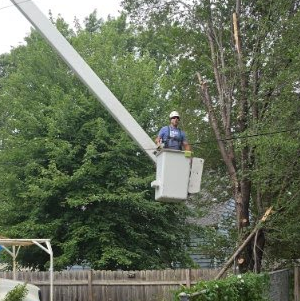
Open access, room to work, and no structures in the fall path. When a Minneapolis or suburban yard looks like that, tree removal is simple: climbed or sectioned down, chipped, hauled, done.
You are here
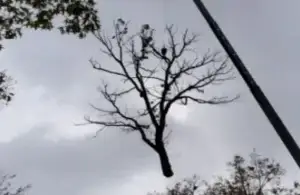
Big tree, tight spot. A boom truck lifts 2,000-lb sections straight up and over the house instead of dragging them across your lawn. As a result, it’s usually faster, and on hard-access jobs it’s often cheaper.
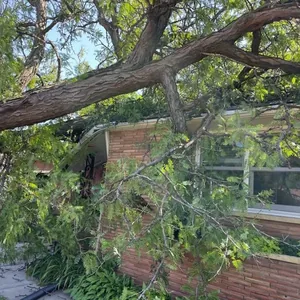
Tree on the house, across the driveway, or into the lines. Live answering, same-day response, and we document everything for your insurance claim.

EAB-killed ash turns brittle within a couple of seasons, so we won’t put a climber in a tree that can’t be safely climbed. Instead, we pick it with the boom truck.
The honest version
Two trees that look identical can get very different tree removal quotes in Minneapolis, and it isn’t the salesperson’s mood. The difference comes down to size, access, and risk, so here’s the honest version.
| Factor | Why it moves the number |
|---|---|
| Tree size and species | Height, trunk diameter, and total tonnage set the baseline. After all, a 25-ft ornamental and a 70-ft oak are not the same job. |
| Access | A front-yard tree the truck can reach is the cheapest version of any removal, whereas a fenced backyard with no equipment access is the most expensive. |
| Condition | Dead, split, storm-damaged, or leaning trees are more hazardous, so they take longer to bring down safely. |
| Proximity to structures and utilities | Over a house, garage, fence, or power lines means rigging, planning, and time, or a crane. |
| Crane or boom-truck requirement | Sometimes it’s the safest option, but it’s often the cheaper one too. (See the crane page for why.) |
| Stump, cleanup, and restoration | Grinding, grindings removal, grading, and resodding are scoped separately so you can choose. |
| Permits and traffic control | When the job needs street closures or city permits, we handle them. |
| Tree size | Typical height | Estimated range |
|---|---|---|
| Small | Up to 25 ft, ornamentals, small evergreens | $300 to $700 |
| Medium | 25 to 45 ft, maples, birches | $700 to $1,800 |
| Large | 45 to 65 ft, ash, oak, locust | $1,500 to $4,000 |
| Very large | 65 ft+, mature oak, cottonwood, silver maple | $3,500 to $6,000+ |
| Scenario | Why | Cost |
|---|---|---|
| Front yard, easy access | Truck and chipper reach the tree | $800 to $1,200 |
| Side yard, fences and obstacles | Hand-carry, careful rigging | $1,500 to $4,000 |
| Backyard, no access, felled by hand | Slow, high-risk, piece by piece | $7,000 to $8,000 |
| Backyard, crane-assisted | Crane lifts sections out cleanly | about $3,500 |
Read that last row again, because on a tight backyard job the crane is often the cheaper option, not the expensive one. In fact, most of our crane jobs save the customer $2,000 or more versus doing it the hard way.
We’re not the cheapest tree company in the Twin Cities, and we don’t try to be. If one bid comes in at $800 when everyone else says $3,000, ask for the written scope, ask for proof of insurance, and ask who’s paying if a limb goes through the roof. We’ve been called out to clean up after too-good-to-be-true offers more than once.
4.8 stars, 133 Google reviews
Big trees
“Gabe (owner) has an awesome crew working for him. These guys were efficient, thorough and professional with my large 70′ ash tree removal project.”
Tom Schibilla
Cleanup
“…able to accommodate a tree removal project under very short notice… I was most impressed with their detail in cleaning up the site. They left our yard in better condition than it was before the project started.”
MIKE Anderson
Certification
“Having a certified arborist matters; this is not a fly-by-night guy with undeserved self-confidence, ‘sure, we have a chain saw.’ This might not be the cheapest but quality matters.”
Katie Trotzky
Straight answers
That’s what the free estimate is for. During the visit, a certified arborist looks at the tree’s condition, structure, lean, and what’s underneath it. Dead trees, major trunk cracks, EAB-killed ash, and trees leaning at a structure usually need to come down. On the other hand, dead branches, roof clearance, and treatable disease usually don’t, and we’ll tell you that even though it costs us the job.
Yes. Brush, logs, and debris are hauled away, and the site is raked and blown clean. That’s included in every tree removal and written into your scope, so there’s no argument later. Stump grinding, however, is quoted separately so you can decide.
It’s a separate line item, not an automatic add-on, because some people want the stump gone, some want to replant, and some are fine leaving it. If you want it gone, we grind below grade, clear the grindings, and can also grade and resod the spot so it looks like the tree was never there.
When the tree is large and the space is tight, close to a house, garage, fence, or power lines, or when it’s too dead to safely climb. A boom truck lifts sections up and over instead of dragging them across your lawn. As a result, it’s often faster, and on hard-access jobs it can cost less than felling by hand.
It depends on the city and whether the tree is on your property or in the boulevard. For example, Minneapolis and St. Paul both regulate boulevard trees, and some cities also require permits or street closures for large tree removals. We know the rules where we work and we handle the permits, so you don’t make the calls.
Yes. We coordinate directly with the utility for line clearance when a removal is close to service drops or primary lines. Above all, do not attempt this yourself, and do not hire anyone who says they’ll “just be careful.”
Planned tree removals in Minneapolis and the suburbs are typically scheduled within days to a couple of weeks, depending on the season and the equipment needed. Emergencies, however, are different: call and we respond same-day.
Any tree on your house, garage, or car counts, and so does one blocking your driveway or the street. The same goes for a tree or limb hung up over something you care about, or a tree into the power lines. If it’s any of those, don’t fill out a form. Instead, call 612-532-9996.
Yes. We document the damage, the work, and the site, and we also deal with adjusters directly. That matters because storm removal claims move a lot faster with proper documentation, and we’ve done this a lot.
A certified arborist will come out, look at it, and tell you honestly whether it needs to come down, and if it does, exactly what it’ll take and what it’ll cost. Written estimate. No pressure. No surprises.
Loading the form…
We read every one of these. If your tree is a hazard right now, call instead: 612-532-9996.
We provide tree removal across Minneapolis, St. Paul, Maple Grove, Plymouth, Brooklyn Park, Blaine, Coon Rapids, Champlin, Osseo, Rogers, Golden Valley, St. Louis Park, Edina, Minnetonka, Eden Prairie, Bloomington, Roseville and the surrounding Twin Cities metro.
Emergency tree service 24/7 across Hennepin, Anoka, Sherburne, and Wright counties.
Loading the estimate form…