
Tree on your house, blocking the driveway, or into power lines? Call 612-532-9996 now. · Live answering · Same-day emergency response
We prune oaks in winter. Call us in June and we will book you for November, and tell you why.
Oak wilt can kill a red oak in about two months, and the beetles that carry it are drawn to fresh pruning cuts from April through July. Once one oak has it, the fungus can reach the next one through grafted roots. So in the growing season the only oak work we take is dead wood and genuine hazards, sealed the moment the cut is made. Everything else waits for the cold months.
4.8 stars across 133 Google reviews. Licensed, insured, and a TCIA member.
Send a photo of one leaf, or the whole tree. We will tell you what it is and when it can be pruned.
On almost every tree, our answer is the one on our tree trimming page: it is your tree, we will tell you the truth about it, and then we will do what you decide. Oaks are the exception, and the reason has nothing to do with your yard.
Oak wilt is a fungal disease, and it kills red oaks fast. The Minnesota DNR puts it at about two months from infection to a dead tree. It travels two ways. Above ground, sap beetles carry its spores from infected oaks to fresh wounds on healthy ones, and a pruning cut made between April and July is exactly that kind of wound. Below ground, it moves from tree to tree through roots that have grafted together.
University of Minnesota Extension cites a Twin Cities study that found most of that underground spread within about 30 feet. Thirty feet is usually your neighbour’s yard. A cut made on your oak in June does not only risk your tree, and that is why this is the one place we will not simply do what you ask.
So we prune oaks in the cold months, when the beetles are not flying. April through October is when most of our work happens, and moving an oak job out of it costs us work in the months we are busiest. We do it anyway.
“Instead of trimming all of our trees, which he had originally quoted, he encouraged us to wait until the fall.”
Clara Nydam
That was a job we had already quoted, and then talked ourselves out of. When the timing is wrong, waiting costs you nothing.
“Treating oak wilt can be difficult and costly, but fortunately, prevention is simple and cheap.” Brian Schwingle, DNR forest health program coordinator, 6 April 2026.
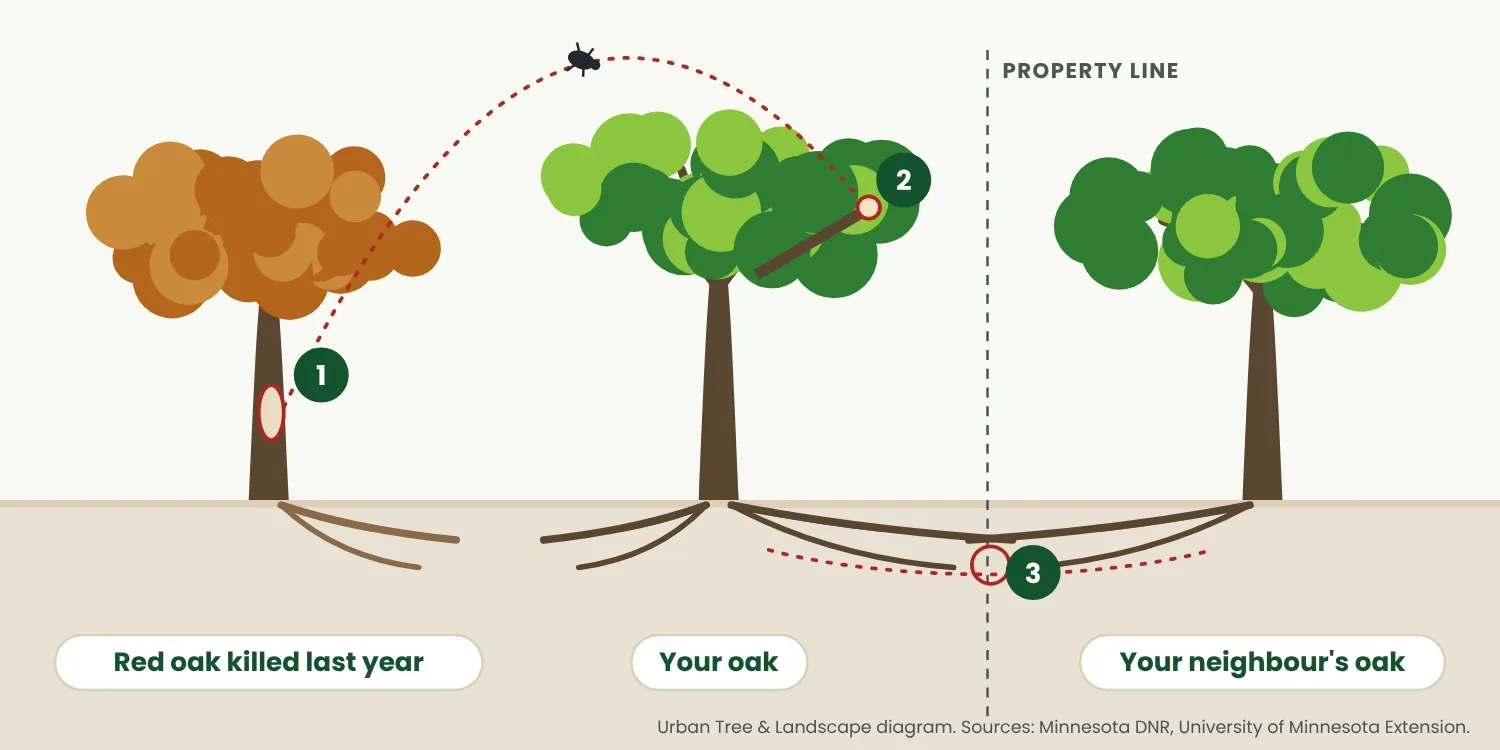
A red oak that wilted the year before grows fungal mats under its bark. Extension says the mats produced April through July matter most, and sap beetles are drawn to them.
The beetles carry the spores to fresh wounds on healthy oaks. The DNR says a wound made in spring can stay open to infection for up to five days.
Neighbouring oaks, usually of the same kind, graft their roots together. Once one is infected, the fungus uses those grafts to reach the next tree, property line or not.
It is the first thing we will tell you at the estimate, because both groups catch oak wilt the same way and die of it at completely different speeds.
The fast one, and the one that spreads it
Leaves with sharply pointed lobes, each lobe ending in a small bristle tip.
Northern red oak, northern pin oak and black oak.
Dies fast. The DNR puts it at about two months from infection, with 90 percent or more of the leaves gone in one to two months. A carpet of leaves under an oak in midsummer is the classic sign.
Red oaks are also how the disease moves overland: about half of infected red oaks grow the spore mats the beetles feed on. Preventive injection only helps a red oak that is still healthy.
The slow one, and the one that can be treated
Leaves with rounded lobes and no bristle tips.
Bur oak, white oak and swamp white oak.
Declines slowly, often a few branches at a time. The DNR says bur oaks die one to seven years after infection, and white oaks one to more than twenty.
That slower pace is what makes it treatable. The DNR notes white oaks can be injected with a propiconazole fungicide once they show early symptoms.
Not sure which you have? Send a photo of a single leaf with your estimate request. That is usually all it takes.
The two Minnesota sources agree on the important part and differ at the edges, so here is each month with what they say and what we actually do. Where they differ, we follow the stricter one.
Yes. This is when we do it.
The DNR and University of Minnesota Extension both call this the safe window. Extension: “Fungal pathogens and insect vectors are inactive.”
Structural pruning, deadwood, clearance and reductions. With the leaves off, every crossing limb and every dead branch is in plain view.
In a cold March, yes, with every cut sealed.
Extension rates March to mid-April as caution, because new overland transmission is possible once the weather warms.
We seal every oak cut we make. If a warm spell comes early, we stop and move the rest of the work to the following November.
Dead wood and genuine hazards only.
The DNR: do not wound oaks from April through July, when oaks are most susceptible to infection. A fresh wound can stay open to it for up to five days.
Any cut we have to make gets tree wound paint or shellac immediately, as the DNR directs. Storm damage over a roof or a drive does not wait for winter.
Dead wood and hazards, sealed. Pruning waits for November.
The DNR says the risk drops after mid-July. Extension still rates these months as low risk, not no risk, and St. Paul Forestry asks owners to wait through October.
We look at your oaks now, while the leaves make them easy to read, and put the pruning on the winter schedule with a firm price.
If you call us in June about an oak, we will book you for winter and tell you why, and that is a job we are moving out of our busiest months on purpose. If you call us in June about the maple over your driveway, that is exactly the right time to be calling, and our tree trimming page has the timing for every other tree. Sources: Minnesota DNR oak wilt guidance, reissued 6 April 2026; University of Minnesota Extension, Oak wilt in Minnesota, reviewed 2026.
Gabe is an ISA Certified Arborist. The plan for your oak, which limbs come out and why, is made by somebody qualified to make it.
Your estimate says which group each oak belongs to, because that decides how much risk the tree carries and what it would take to protect it.
Every cut lands at the collar so the tree can seal it. No flush cuts, no stubs. On an oak, a stub is an open door for longer than it needs to be.
Oak wilt and Dutch elm move on fresh wounds. Sanitising between trees is not optional in Minnesota.
Any oak cut we make from March through October gets wound paint or shellac immediately. In the November to February window the sources do not call for it.
“They raked up all the debris and even took leaf blowers to fluff up the grass. Seriously!” Jeff Matthies
Pruning in winter is prevention. If an oak is already wilting, the job changes: confirm what it is first, then protect the oaks around it.
Extension is blunt about firewood: do not move logs or firewood from recently wilted oaks. And Hennepin and Ramsey are quarantined counties, so hardwood firewood cannot leave them unless it is MDA-certified.
The DNR recommends a lab confirmation before you pay for any control. Plenty of dying oaks turn out to be drought, borer or blight.
Depending on the trees, that means a root graft barrier cut about five feet deep, usually from August until the ground freezes; preventive propiconazole injection of healthy oaks nearby, which protects for up to two years but does not stop spread through the roots; or both.
A red oak that has died of oak wilt comes down after the ground is frozen, and its wood gets tarped, chipped or burned before spring, not stacked by the garage.
We will look at the tree, tell you honestly whether it looks like oak wilt or one of its lookalikes, and lay out which of these steps your yard actually needs and what each one costs. Treatment is part of our tree health care work, and if a tree is past saving, our tree removal pricing is published.
Leaves make it easy to tell a red oak from a white oak and to spot dead wood. An arborist walks the property with you and says what each oak needs, including nothing.
Which oaks, which cuts, what it costs, and when we expect to be there, in writing. Book in summer or fall and you have the number months before the crew arrives.
Leaves off, beetles inactive. Cuts to the branch collar, saws sanitised between trees, climbers or the lift depending on access.
Brush chipped and hauled, the yard left clean, and a walk-through so you can see every cut before we leave.
Two oaks that look alike from the street can be quoted very differently. Here is exactly what changes the number.
Mature oaks are wide, heavy-limbed trees. A 30-foot pin oak and a 70-foot bur oak spreading over a roof are different jobs with different gear.
A front-yard oak we can reach with the lift is the cheapest scenario there is. A backyard oak behind a fence, with no gate wide enough for equipment, has to be climbed and rigged piece by piece, and that is time.
A limb over open lawn drops. The same limb over a roof, a fence or a power line has to be roped and lowered, and that can double the hours on one branch.
A deadwood pass on a healthy oak is a fraction of a full structural prune on one that has been left alone for fifteen years.
Several oaks in one winter visit cost meaningfully less per tree than one at a time, because the setup and the haul are shared.
Chipped and hauled is standard. Wood from a healthy winter prune can be cut to length and left for you. Wood from an oak that died of oak wilt has rules, and we will explain them.
We have not published oak pruning ranges, for the same reason our tree trimming page does not: pruning varies more per job than removal does, and a range wide enough to be honest would not help you. You get a firm number in writing before anyone starts, and because oak work is booked ahead, you have it months before the crew arrives.
“He was also transparent with me about not spending another dime on one of my trees that appeared stressed and giving it a few years before deciding what to do with it, saving me from doing unnecessary or even harmful work on that tree.”
Courtney Barton
“Having a certified arborist matters; this is not a fly-by-night guy with undeserved self-confidence, ‘sure, we have a chain saw.’ This might not be the cheapest but quality matters.”
Katie Trotzky
“They stick to their estimates and there are no surprises.”
Alex Molldrem
4.8 stars across 133 Google reviews
November through February is the window every Minnesota source agrees is safe. The DNR says do not wound oaks from April through July, when they are most susceptible to oak wilt. University of Minnesota Extension rates August through October and March to mid-April as caution periods, when infection is less likely but still possible.
We do structural oak pruning from November through February, take dead wood and genuine hazards in the other months, and seal every cut we make outside the safe window.
Dead wood and hazards, yes. Full pruning, we wait for November. The DNR says the risk of wound infection drops after mid-July, but Extension still rates August through October as low risk rather than no risk, and St. Paul Forestry asks private owners not to prune oaks from April through October. Fall is the best time to have your oaks looked at, though, because the leaves make it easy to see what each tree needs.
The cut is a fresh wound, and sap beetles carrying oak wilt spores are attracted to fresh wounds from April through July. The DNR says a wound can stay susceptible for up to five days. If the tree is infected, a red oak can be dead in about two months, and the fungus can then move through grafted roots to the oaks next to it. If a cut has already been made, cover it with latex paint or shellac right away.
Deal with it now. A broken limb is a hazard and an open wound already, so the calendar does not apply. The DNR’s guidance is to apply tree wound paint or shellac to the wound immediately, and that is exactly what we do. If it is over a roof, a drive or a walkway, call it in as emergency tree work.
Only outside the safe window. The DNR and Extension both call for paint or shellac on any oak wound made in the risk months, applied immediately, and Extension specifies latex rather than oil-based paint. From November through February the beetles and the fungus are inactive, and neither source asks for it.
Look at the leaf. Red oaks, including northern red oak and northern pin oak, have sharply pointed lobes with a small bristle at each tip. White oaks, including bur oak, white oak and swamp white oak, have rounded lobes. It matters because red oaks die of oak wilt in about two months, while bur oaks take one to seven years and white oaks can take more than twenty.
On a red oak, look for leaves turning brown from the edges inward, starting at the top of the crown, and a carpet of fallen leaves under the tree in midsummer. On a bur or white oak, look for a few wilting branches that get worse year to year. Bur oak blight, anthracnose, two-lined chestnut borer and drought can all look similar, which is why the DNR recommends a lab confirmation before paying for any treatment.
Some do. Ham Lake requires a city permit to cut an oak between April 1 and July 15. Edina has a city inspector with the authority to inspect for oak wilt on private property, and Eden Prairie enforces removal of diseased trees by a set date. St. Louis Park reimburses part of the cost of oak wilt treatment. Boulevard trees belong to the city in Minneapolis and St. Paul, so those are never yours to prune. We will check what applies to your address.
Wood from a healthy oak pruned in winter, yes. Wood from an oak that died of oak wilt is different: Extension says not to move logs or firewood from recently wilted oaks, and the DNR says to tarp that wood from April through July or chip, burn or debark it before April. Separately, Hennepin and Ramsey are quarantined counties, so hardwood firewood cannot be taken out of them unless it is MDA-certified.
It depends on the size and spread of the oak, how we get to it, what is underneath it, and how much is actually coming out. Several oaks in one winter visit cost less per tree than one at a time. We do not publish pruning ranges because they would have to be so wide to be honest that they would not help you. You get a firm number in writing before anyone starts.
Every other tree, and most of them can be pruned right now. The timing for each species is on the page.
If an oak is thinning, wilting or dropping limbs, the answer starts with a diagnosis, not a saw.
When an oak really is finished, we will say so, and our removal pricing is published.
Send a photo, or have an arborist walk the property while the leaves are still on. We will tell you which of your oaks are red and which are white, what each one needs, and when we can do it. If an oak needs nothing this winter, we will say so.
Loading the form…
Ask your neighbour, then call.
Loading the estimate form…